
Sponsored Partner Post: Edward Jones Millions of Americans set money-related resolutions each January, such as…
Project EAGLE: An Alternative Approach for Identifying Talent
Sponsored Partner Post: UCONN Project Eagle
Each year, tens of thousands of students are not identified for gifted services simply because traditional identification systems fail to recognize their talent potential. Many of these students come from underserved populations, including those who learned a language other than English as a child. For this latter group, teachers too often focus on students’ limited English proficiency and overlook the brilliance they possess.
Project EAGLE was designed to address this problem by adapting learning activities that help educators identify math talent and potential giftedness in students who can be overlooked by traditional identification systems. The Project EAGLE approach uses mathematics as a vehicle to uncover gifted behaviors.
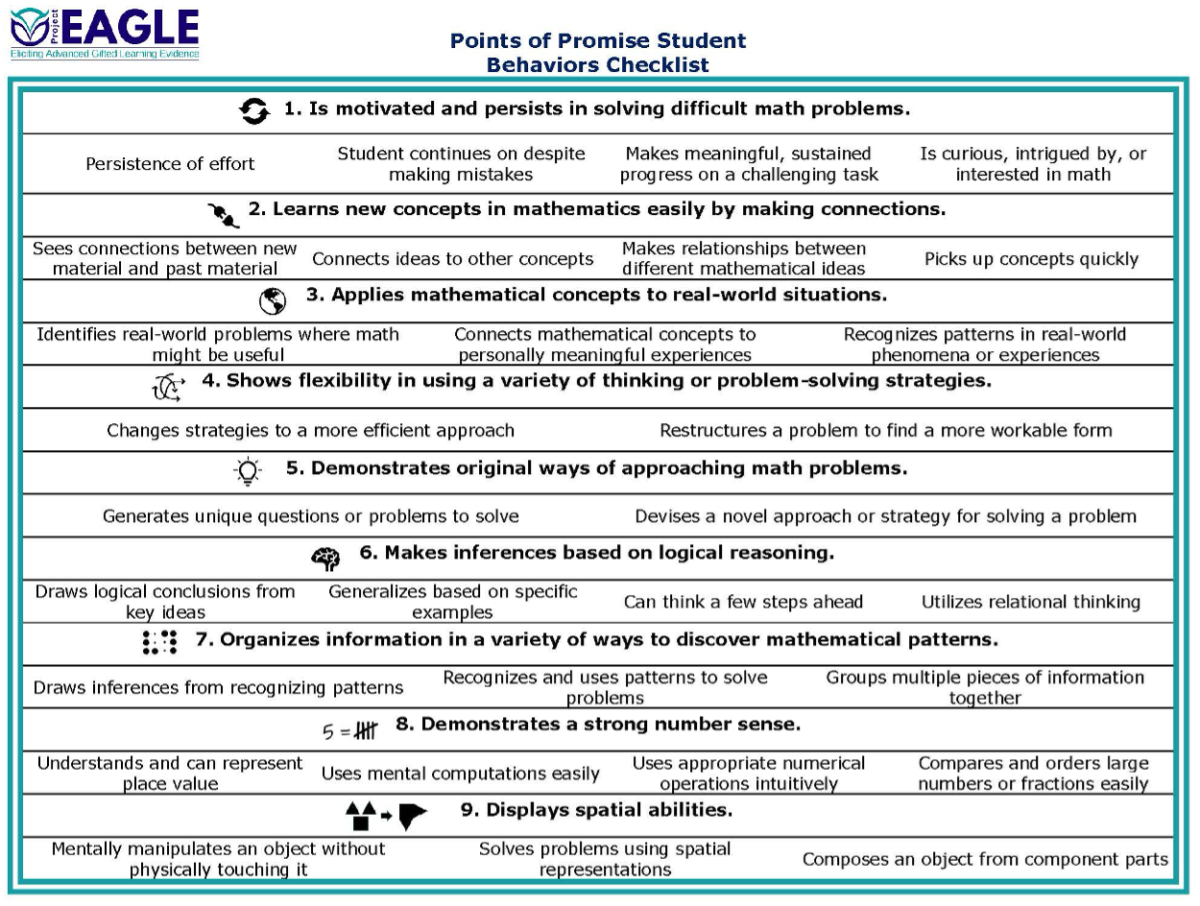
In Project EAGLE, we’ve adapted five one-hour math lessons that elementary teachers in Grades 3–5 embed throughout the academic year. Each lesson is designed to elicit specific gifted behaviors commonly observed in talented students. We have identified nine such behaviors based on mathematically gifted checklists and behavioral rating scales and refer to them as Points of Promise.
While teaching the five lessons, teachers observe students and take note of any Points of Promise they exhibit. Although not every lesson is intended to elicit all nine behaviors, teachers should be able to observe all Points of Promise across the five lessons. No student is expected to display all nine behaviors, but any student who exhibits one or more Points of Promise should be considered for further evaluation for gifted services. Displaying a Point of Promise doesn’t necessarily mean a student is gifted, but this is a student that teachers should take a second look at and determine if this student might benefit from gifted services.
Points of Promise
For each of the nine Points of Promise, we have created student language for it, and identified two to four common behaviors associated with that Point. These descriptions help teachers better understand what each Point of Promise looks like in the classroom. We have also created three different styles of checklists that teachers can use to organize and document their observations during the lessons.
Motivation
1 – Is motivated and persists in solving difficult math problems. (Student language: I enjoy working on math and continuing to try to find the answer even when the problems are difficult.)
These students may demonstrate persistence despite setbacks, make meaningful and sustained progress on challenging tasks, and show curiosity or intrigue about math. A student exhibiting motivation and persistence might express a desire to continue exploring math outside of class time, articulate where they are stuck and ask for help, persist even when problems are initially difficult, and challenge assumptions or boundaries. For example, in the lesson Is It Worth It?, a student might repeatedly adjust and rearrange shapes to meet the parameters on the card, review their own errors, and ask questions that help them move closer to a solution.
Connections
2 – Learns new concepts in mathematics easily by making connections. (Student language: I connect what I am learning to what I have learned before in math.)
These students may recognize connections between new and previously learned content, relate concepts to broader themes, identify relationships among different mathematical ideas, and grasp new ideas quickly. This behavior is evident when students explain how current material relates to something they previously learned in math, complete tasks that require integrating multiple mathematical concepts, or describe how a skill represents a larger idea. For example, during the lesson Keep Your Balance, students might explain how balance and equivalence are related or make analogies to weighted scales when working to balance shapes and quantities.
3 – Applies mathematical concepts to real-world situations. (Student language: I relate the math we are learning to everyday life outside of math class.)
These students may identify real-world problems where math could be useful, connect mathematical concepts to personally meaningful experiences, or recognize patterns in real-world phenomena. This Point of Promise may be observed when students suggest ways to apply the math they’ve learned to situations outside the classroom, create or use analogies between math and real-life experiences, or connect patterns they’ve seen in nature to mathematical concepts. An example from Fraction Feud might be a student who describes a situation where they used fractions to determine whether their sibling fairly divided a treat.
Creativity
4 – Shows flexibility in using a variety of thinking or problem-solving strategies. (Student language: I try different strategies to solve math problems.)
These students may change strategies to adopt a more efficient approach or restructure a problem to make it more workable. In the classroom, this might look like students solving a problem in multiple ways until they find the simplest solution or finding alternative methods to solve a problem when they don’t have the answer memorized. They may not always arrive at the correct answer or choose the easiest method, but their mathematical thinking will be evident. In Is It Worth It? for example, a student might use previous solutions to inform their approach to a new problem or begin the next problem with a different strategy. If a student initially started by identifying the shape and found it difficult, they might instead begin with the cost.
5 – Demonstrates original ways of approaching math problems. (Student language: I think of new ways to solve math problems and new problems to solve.)
These students may generate unique questions or problems to explore in the classroom or devise novel approaches or strategies for solving problems. You might notice a student solving a problem in a way that was not discussed with the class or using a method you did not anticipate. You may also observe a student who asks new, insightful questions in response to a task. For example, in Measuring Up, a student might restructure the shape of an irregularly shaped room into a rectangle to calculate the perimeter, rather than adding each side individually.
Patterns
6 – Makes inferences based on logical reasoning. (Student language: I use logical reasoning to make sense of math problems and determine what to do next.)
These students may draw logical conclusions from key ideas, generalize from specific examples, think several steps ahead, or use relational thinking. This may be evident when students explain how they believe something works and support their ideas, make generalizations based on the examples they’ve been given, or attempt to work ahead and offer answers before being asked. During Keep Your Balance, for instance, a student might make general statements about the best way to balance an equation. Even if their strategy doesn’t apply to every scenario, they are able to support their reasoning using accurate information from the problems they’ve already solved correctly.
7 – Organizes information in a variety of ways to discover mathematical patterns. (Student language: I recognize patterns in math and use them to organize information.)
These students may draw inferences by recognizing patterns, use patterns to solve problems, or group multiple pieces of information together. This behavior may be evident when students predict what comes next, identify relationships among items, or notice common features across different problems. In the lesson Keep Your Balance, for example, students might organize their data to determine whether all possible equations have been found or explain the patterns they observed that helped them balance the scales.
8 – Demonstrates a strong number sense. (Student language: I understand and use relationships between numbers to order, compare, and estimate.)
These students may perform mental computations with ease, use appropriate numerical operations intuitively, compare and order large numbers or fractions accurately, and demonstrate a solid understanding of place value, including how it is represented. In the lesson As a Rule, a student might quickly realize that using the additive and multiplicative identities—0 and 1, respectively—is helpful in determining the rule.
9 – Displays spatial abilities. (Student language: I can figure out how shapes fit together in different ways.)
These students may mentally manipulate objects without physically touching them, solve problems using spatial representations, or compose objects from component parts. These abilities may be evident when students visualize solutions without needing manipulatives, create multiple representations of shapes, or use shapes to construct new forms. In Is It Worth It? for example, students might generate multiple correct shapes for a single problem or determine the correct answers without using the provided manipulatives.
About the Math Lessons
The five Project EAGLE lessons address different mathematical domains. Keep Your Balance focuses on algebraic thinking and number operations; in this lesson, students balance a scale using shapes and various equations. Is It Worth It? addresses geometry and measurement, where students play a pattern block game and create different shapes based on perimeter, number of sides, number of blocks allowed, and the total cost of the shape. Fraction Feud centers on fractions, with students playing a card game to compare different fractional values. In As a Rule, students infer a mathematical rule based on input and output numbers. A machine operator spins a spinner to select a rule, and students take turns providing input numbers while the operator gives the corresponding output. In Measuring Up, students role-play as architects, finding missing measurements on house plans as they solve for the area and perimeter of various rooms.
The Dynamic Approach
The advantage of Project EAGLE’s dynamic, classroom-based approach is that it moves beyond static pencil-and-paper assessments, enabling teachers to interact with students as they thoughtfully solve problems using a dynamic IN:OUT framework for each lesson. IN represents opportunities to Inspire students to engage (e.g., by encouraging them or highlighting relevance) and to provide Nudges that help students initiate tasks (e.g., by offering context or clarifying directions). OUT represents opportunities for teachers to Orient themselves to students’ thinking, assess their depth of Understanding, and explore their ability to Transfer that understanding.
Project EAGLE offers a powerful alternative to traditional gifted identification by embedding dynamic, thoughtfully designed math lessons into the general education classroom. Rather than relying on static assessments that may overlook students from underserved backgrounds—particularly multilingual learners—Project EAGLE enables teachers to recognize gifted behaviors in real time through observation and interaction. By focusing on nine distinct Points of Promise across five engaging math lessons, the approach highlights students’ mathematical thinking, creativity, persistence, and reasoning. With built-in prompts and probes to guide teacher observations, Project EAGLE equips educators to notice potential that might otherwise go unseen, ensuring more equitable access to advanced learning opportunities.
Free 6-Hour Workshops on Project EAGLE in AZ!
Interested in learning more? Project EAGLE is offering NO-COST workshops in Arizona during the 2025-26 academic year for teachers and administrators working with grades 3–5. Workshops include 6 hours of training in the EAGLE approach, which includes identifying gifted math behaviors and SEI strategies. This may satisfy GT, ESL, or math training hours, depending upon district requirements and each attendee will receive a bound copy of the EAGLE lessons for classroom use. If you’re an educator in Arizona interested in hosting or attending a complimentary one-day Project EAGLE workshop, visit https://identifygifted.education.uconn.edu/trainer/ or email projecteagle@uconn.edu.
Also, visit our table at the Arizona Association for Gifted and Talented’s 52nd Annual Conference – “Gifted. Seen. Heard. Served” taking place February 10–11, 2026 or attend our session “Empowering Change by Discovering Unrecognized Talent.”
Project EAGLE is funded by Jacob K. Javits Gifted and Talented Students Education Program, U.S. Department of Education PR/Award #S206A220040
Related Posts